Introducing an energy efficient system suitable for venusian surface missions
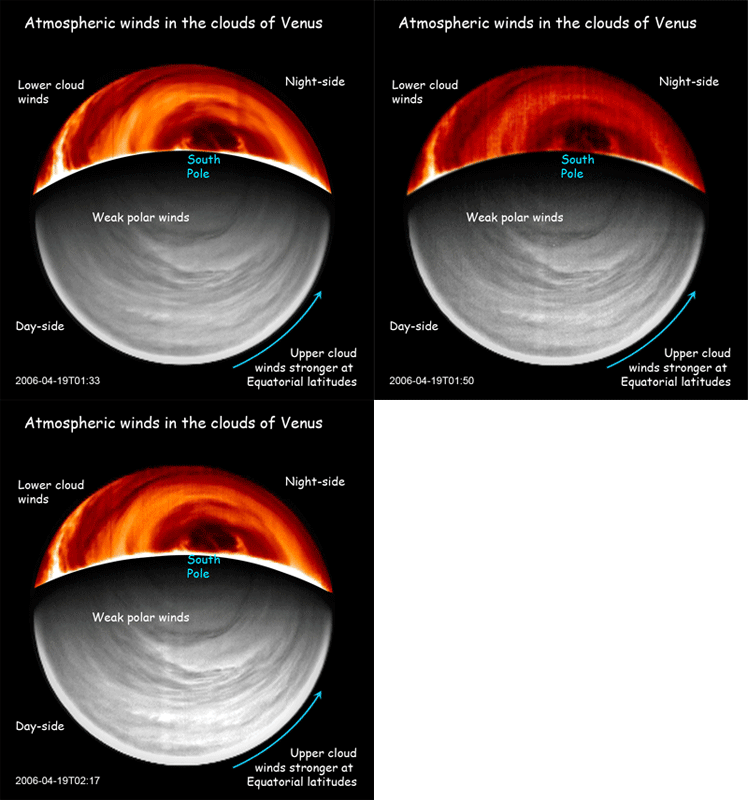
In overcoming the heat and pressure challenges on venus, Our conceptual design for a power system can operate under Venus ambient conditions. Our generator makes use of the wind energy on the planet converting it into electricity to power our rover system. It does not require a power storage system due to the continuous wind blowing on the planet's surface. This is highly advantageous as it eliminates the struggle to overcome the challenges posed by heat and the planet's surface pressure. Using this, our exploration time could be limitless! The use of piezoelectricity here keeps our costs of design low and eliminates the need to provide heat shields to the power system.
WHAT EXCATLY DOES IT DO?
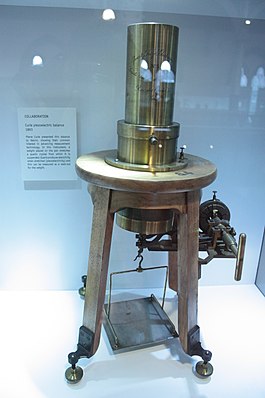
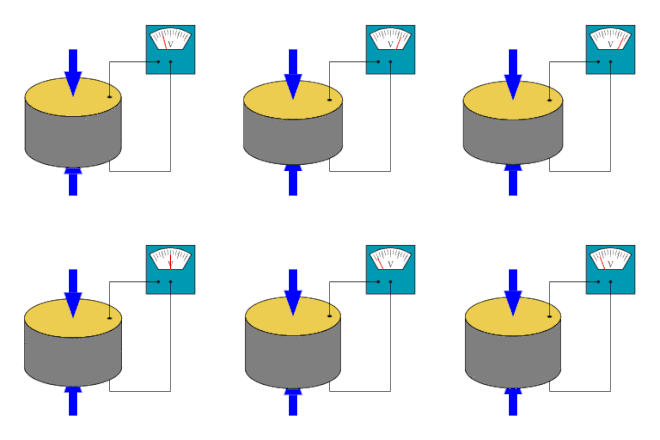
We developed a power generating system that utilizes crystals with anisotropic structures to generate PiezoElectricity. It utilizes the wind on Venus to provide the stress required to polarize the polycrystalline piezoelectric material thus setting up a potential difference across the terminals of the crystals
Eleifend auctor turpis magnis sed porta nisl pretium. Aenean suspendisse nulla eget sed etiam parturient orci cursus nibh. Quisque eu nec neque felis laoreet diam morbi egestas. Dignissim cras rutrum consectetur ut penatibus fermentum nibh erat malesuada varius.
SPECIFICATIONS AND FEATURES
The power system consists of an outer rigid cylindrical casing, that has a perforated bottom as shown above. Next is a layer of our piezocells, all enclosed in a perforated cylindrical wall (to ensure that pressure inside the perforated cylindrical wall balances the one outside), with a piston which sandwiches the piezocells. The piezocells are firmly attached to the piston, such that if the piston moves, they are either compressed or strained. The piston consists of a spring with a relatively high stiffness factor. The spring is attached on to the frame at positions 1 and 2 as shown on the diagram. The frames are attached to an axle, with a wind sail on the far end of the axle. The frames are in such a way that they only rotate up to 180 degrees from positive x direction to negative x direction or from negative x direction to positive x direction.
DESIGN
It is designed in such a way that the maximum compression of the piezoelectric material happens when the frame is in the vertical position, and also ensuring that at 180 degrees, the pull on the piezo electric material does not break the material.
WORKING
Initially, the spring is in a relaxed position, with the frame making an angle to the horizontal. When wind blows, the sail rotates in the direction of the wind causing the spring to either push or pull on the piston which turn either compresses or pulls on the piezocells leading to setting up of a potential difference across the terminals. When the wind stops blowing, the springs bring back the frame which in turn is connected to the sail back in the relaxed position. Given the fact that Venus is a windy planet, there is a high probability of the cell generating power continuously for the collection of data.
BENEFITS IT HAS
- It utilizes a renewable energy source which is wind.
- Plus, the piezoelectric material in the piezocells will keep generating power given the fact that wind is available.
- It does not require a pressure containment.
- It suffers very minimal damage from heat as the materials are heat resistant and also have a thermal protective coating on them.
WHAT WE HOPE TO ACHIEVE
• We hope to achieve a cheap efficient power renewable generating source rather than a power storage system.